A bank arrived by mail. Ten bricks at a time
Salt Lake City, 1916. Ten bricks sit inside a wooden crate, each wrapped in paper. These are not samples. At the far end of the route, a bank needs a facade.
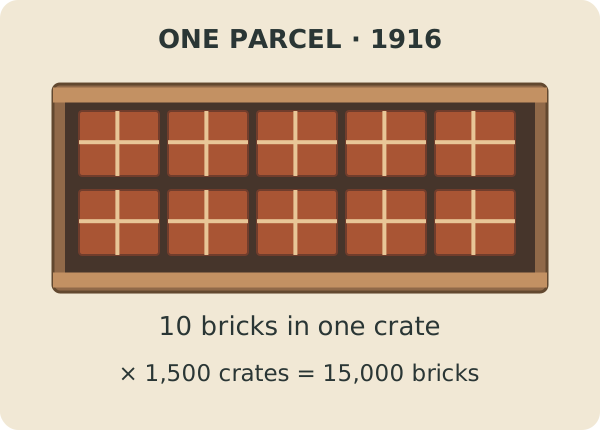
Another 1,499 crates like this
William Horace Coltharp, a director of the Bank of Vernal in Utah, wanted a handsome facade. Most of the building could use local brick. For the exterior, he chose pressed brick from Salt Lake City. The order had to reach a town with no railway.
His solution looked like a joke at the postal clerk’s expense: wrap the bricks individually and pack ten into each wooden crate. A parcel could then meet the applicable 50-pound weight limit. According to a brick-company representative’s recollection, cited by the USPS historian, 15,000 bricks were mailed in 1,500 crates. The Smithsonian’s postal museum gives the same count.
The mail carried the facing bricks, not the entire building. That distinction would have offered limited comfort to anyone unloading the next crate.
A short line. A long journey.
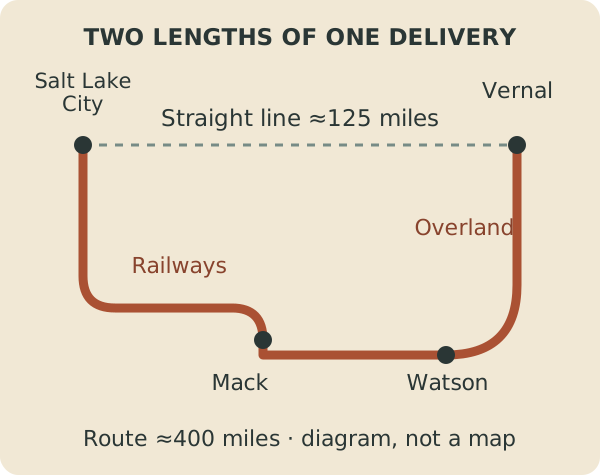
Salt Lake City and Vernal are only about 125 miles apart as the crow flies. That put them in a nearby postal zone: mailing a 50-pound parcel cost 54 cents. Mountains made a nonsense of the straight line. The actual journey ran to nearly 400 miles, using two railways through Mack, Colorado, to Watson, Utah, followed by another 54 miles overland.
USPS records a payment of 75 cents to the carrier for that final leg alone, per 50 pounds. The Post Office was already 21 cents behind before paying for the railway journey. A bargain for the sender had not made the load any lighter.
One brick-laden truck broke a drive chain while climbing uphill; its brakes failed. It rolled backwards, overturned and caught fire. The driver was unhurt, but most of that load was lost.
The crate passes. What about the whole load?
Choose a rule that measures the total load, then compare it with the historical instruction below. This is a rules puzzle, not current postal advice.
Answers and explanations
- No individual crate may exceed 50 pounds: That checks one parcel. A hundred compliant crates would still pass exactly the same check.
- Count the total weight from one sender to one addressee in a day: Now the whole consignment has a unit of measurement. Splitting the load into crates no longer hides its total weight.
- Wrap every brick separately: Wrapping may protect the contents, but it does not reduce the total weight that must travel.
There was already a warning in the rules
Since 1914, US postmasters had been told to seek instructions before accepting a very large or unusual number of parcels of the same merchandise addressed to one post office. But “very large” had no number attached. Postmasters interpreted it differently.
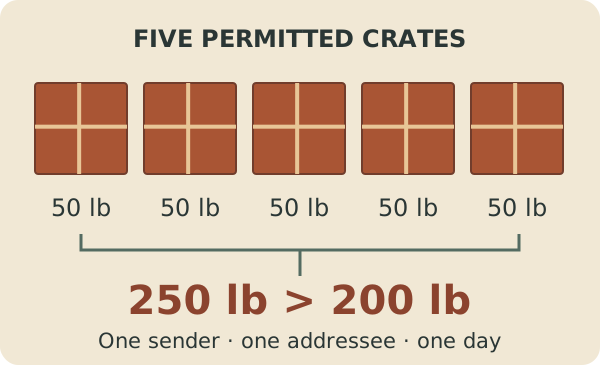
On 7 November 1916, Postal Bulletin No. 11191 supplied a measurable condition: more than 200 pounds of nonperishable merchandise from one sender to one addressee on the same day. Before accepting it, the postmaster had to request instructions and wait. The Vernal bricks were one reason for the clarification. This was a US postal instruction, not a special ban aimed only at the bank.
The fifth crate changes the question
Imagine five crates weighing 50 pounds each. Every crate meets the individual limit. Together they weigh 250 pounds: under the 1916 instruction, matching sender, addressee and day would trigger a request for approval. The check now applies to the whole consignment.
So the familiar ending, “they banned mailing buildings”, tidies the story too much. The instruction required approval for a large shipment; it was not a permanent, building-specific ban. The requirement to await instructions for these shipments was removed in July 1959.
The bank moved into its new building in February 1917. In the wall, the bricks finally stopped being mail.