They turned an office building. The phones kept working.
Moving the walls was only part of the problem. Follow the rollers, flexible pipes and traveling front door of Indiana Bell’s headquarters, then the call that passed through it.
A change of address without hanging up
Imagine leaving your desk for lunch and returning to the same room, on the same floor, in a building that has moved a little farther down the street. In Indianapolis in 1930, that was a real possibility. Indiana Bell moved its occupied eight-story headquarters and turned it through a right angle while its telephone equipment continued operating.
The building was substantial: a steel frame wrapped in brick, about 100 by 135 feet across. But its weight was only part of the problem. A working building has connections everywhere. Water arrives. Waste leaves. Electricity enters. People need a way through the front door. Here, telephone conversations also had to pass between the moving structure and the stationary city.
The extraordinary part of the move was everything that had to keep happening as if nothing unusual were going on.
First, make room
Indiana Bell wanted to build larger premises along Meridian Street. Its existing headquarters stood in the way. Moving it to the rear of the property would free the valuable frontage while keeping the old offices and equipment useful.
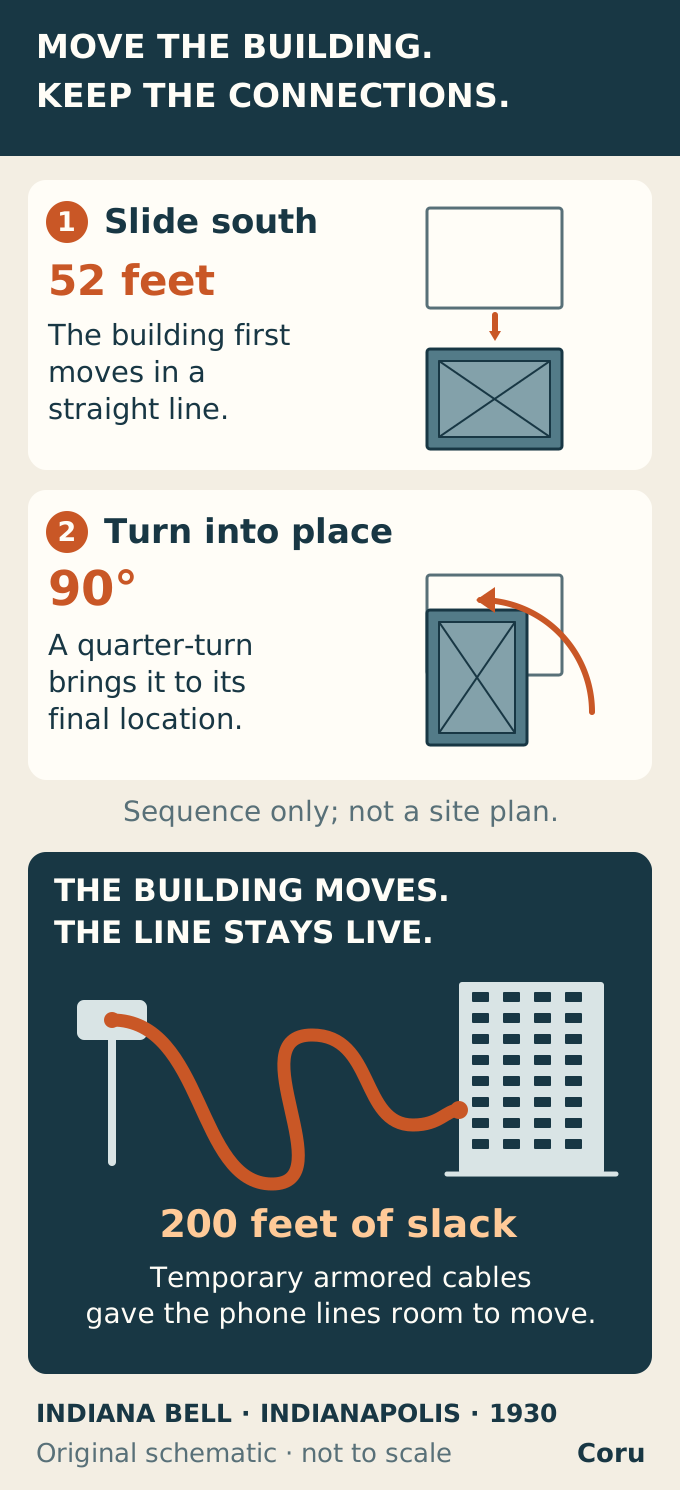
The route was carefully chosen: first, a straight move 52 feet south, roughly 16 meters; then a 90-degree turn into the final position. The contemporary engineering account describes those two stages. The destination was built into the geometry of the turn.
Try the problem with a small book on a table. Turning it around its center sweeps out one area; turning it around a corner sweeps out another. The choice changes both where the book ends up and what it might hit. The actual building had much less freedom: neighboring structures and streets bounded the available space.
Its journey therefore began with work that a dramatic picture of the rotating façade cannot show.
Give it a temporary underside
Crews stripped out the basement walls and floor, exposed the steel columns, and installed a framework of heavy beams. New foundation footings were prepared at the destination. Across the route they built a concrete base, laid timbers over it, and added railway rails to spread and support the load.
The rollers were solid steel shafts. Workers raised groups of columns with screw jacks, inserted the rolling supports and transferred the weight onto them. This was a carefully supported structure changing foundations, not a brick block simply dragged off the ground.
For the straight move, eighteen men operated eighteen jacks. They worked to a whistle, moving the handles together, pausing, and repeating. Alignment checks mattered as much as forward progress: a push that twisted the frame would not be a successful push.
The turn required another change underneath. The shoes and rollers were repositioned for the curved journey. Jacks pushed from one side while steel cables, worked by a stationary steam engine through tackle blocks, pulled from the other. The large building advanced through many coordinated small movements.
The connections had to move too
Now return to the ordinary things inside. How do you wash your hands in a building that is traveling away from its pipes?
Temporary flexible hoses kept the gas, water, sewer and steam-heating services connected. Electricity came through overhead temporary leads. The solution was not to make the whole street move, but to give the connections enough freedom to accommodate the building's changing position.
Telephone wiring received a particularly substantial extension. The engineers spliced in seven large armored cables of a type used underwater, providing 200 feet of slack. Five carried long-distance circuits; two connected to local offices. Local telephone equipment also remained in the neighboring Lincoln-Riley building, which did not make the journey.
That distinction matters. This was not a whole city's telephone system rolling down the street. It was an operating headquarters and long-distance facility whose links to the rest of the network had been prepared for movement.
The elevators needed their own adjustment. Normally they could descend into the basement. With that space opened up for the move, safety apparatus stopped them at the first floor instead. A successful relocation depended on noticing such an unglamorous detail before someone pressed a button.
Follow the front door
There was still a gap between the moving entrance and the public sidewalk. A steel-and-concrete bridge solved it. One end rested at the entrance; the other was supported on rollers near the sidewalk. During the turn, a temporary curved walkway kept that bridge connected to the street. The rear fire escape also remained usable.
Look at the move this way and the façade becomes only one part of the story. Beneath it, the rollers must follow the route. Behind it, the cables must retain their slack. Beside it, people must still be able to leave. Each small connection has a different job, and every one has to keep up.
The contemporary account reports that the movement was too gradual for occupants to feel. To notice it, a person could line up an object outside and check how its position changed later. The familiar view became a slow measuring instrument.
One ordinary conversation
The moving operation ran from October into November 1930. Reaching the destination was not the end of the construction work: transferring the building from rollers onto its permanent foundations took about another month. The impressive turn was one stage in a much longer preparation and rebuilding job.
The January 1931 account by Vance Oathout and W. H. Harrison includes a smaller event. While the move was underway, a young man in Australia spoke by telephone to his father in an Indianapolis hospital. Their conversation passed through the temporary cables.
We do not know their words from that account. We know that, while a building changed its position in the city, two people were still able to reach each other. That was what all those rollers, hoses and spare lengths of cable were there to protect.